Cold storage warehouses need continuous insulation with a vapor retarder on the warm side of the assembly. That insulation exists to keep the dew point outside the building envelope. When it fails, water vapor condenses on the underside of the roof deck and drips onto whatever sits below.
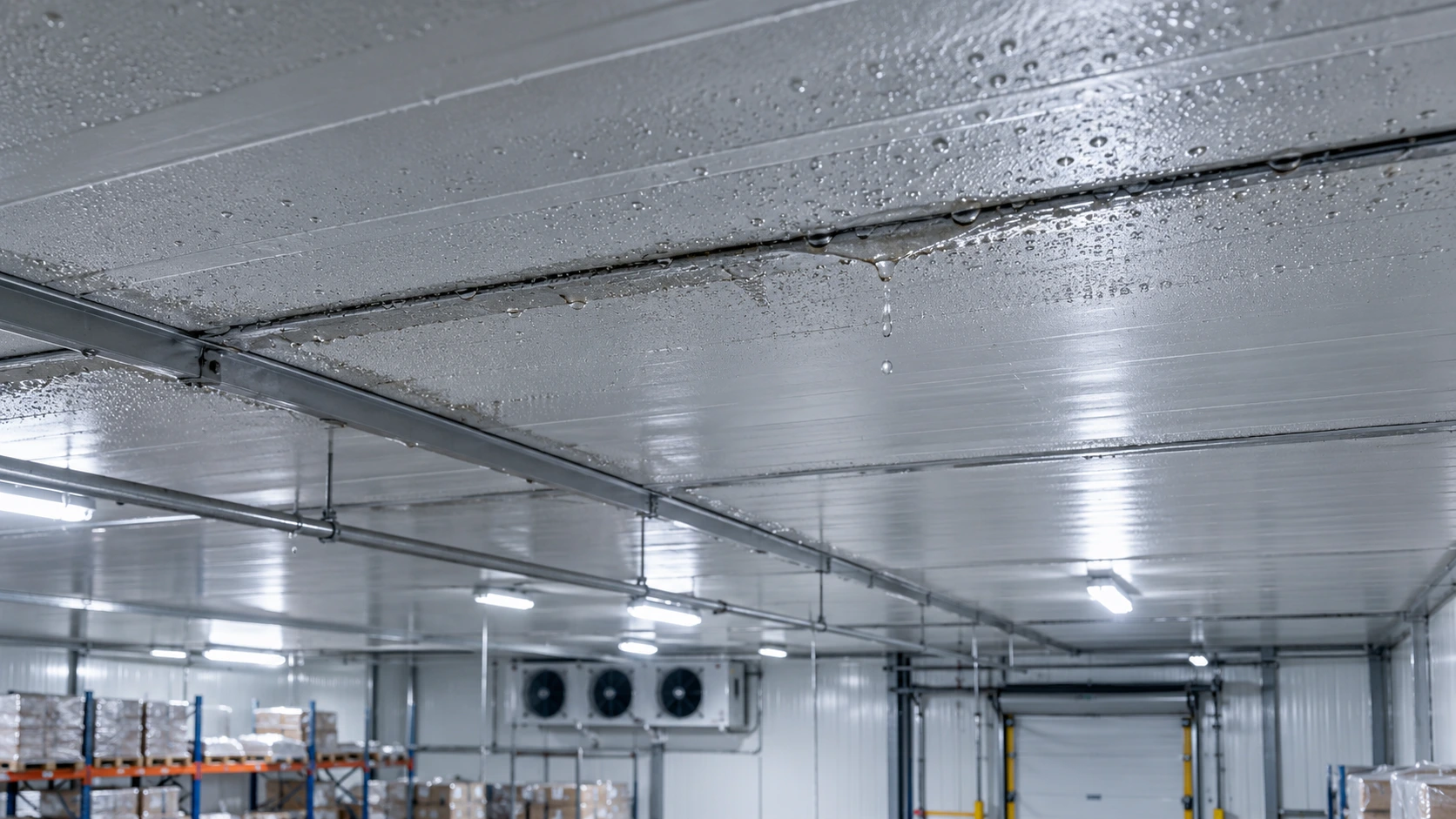
You walk into your cold storage warehouse and see water beading on the ceiling. Drips land on pallets and packaging. Someone left a door open, you assume. But the sweating keeps happening, and it is not going to stop until you fix the insulation.
Standard insulation was never specified for the loads a cold storage roof carries. Most facility managers learn that after the damage is done. Here is what the condensation means and what to do about it.
Why the Ceiling Sweats in the First Place
Condensation forms when warm, humid air meets a cold surface. In a cold storage building, the deck above the freezer is warm. The air inside is cold. When the insulation between them is too thin, has gaps, or is the wrong type, the temperature gradient shifts and the dew point moves inside the assembly.
Water vapor migrates from the warm side toward the cold side. When it hits a surface at or below the dew point, it condenses. That is the water you see. In a food-grade facility it is also a contamination route and a clear signal that the building envelope is failing.
In a freezer or a cooler, the interior sits below the outdoor dew point for most of the year, so the vapor drive runs inward almost continuously. Florida makes it heavier because the outdoor air carries more moisture to push. Michigan gets the same drive through the humid months and adds freeze-thaw damage on top. The symptoms look alike in both places: dripping ceilings and wet insulation, with rust following on the deck.
What a Sweating Ceiling Costs You in an Audit
A sweating ceiling is an audit finding waiting to happen. Condensation over exposed product or packaging is a standing finding in food safety audits. If an inspector sees water on the ceiling, you get a corrective action at best. At worst you lose product and you lose trust.
Envelope insulation minimums are set by climate zone in the International Energy Conservation Code, section C402. Michigan and Florida sit in different zones, so the same building gets different requirements depending on where it stands. Refrigerated space adds demands on top of that baseline, which is why a cold storage roof is rarely a straight application of the commercial minimum.
A roof coating can seal the surface, but it cannot fix an insulation problem underneath. The coating stops water from entering from above. It does nothing about the vapor drive from below. The assembly has to be right before the coating becomes the final layer.
What the Wrong Insulation Does Over Time
Wet insulation loses its R-value. Fiberglass that gets soaked stops performing. Foam board with a failed vapor retarder holds water against the metal deck, which rusts from the inside out. You will not see the rust until the deck has already lost strength. At that point the scope has moved from insulation to structure.
In both Michigan and Southeast Florida, the seasonal swings punish bad assemblies. In Michigan, freeze-thaw cycles expand any water that freezes inside the insulation and crack it open. In Florida, constant heat and humidity drive moisture in faster. The result is the same: a shortened roof life and higher energy bills, in a facility that never feels dry.
How to Fix It Before It Gets Worse
The fix starts with an assessment. You need to know what is in your assembly, where the dew point sits, and whether a vapor retarder exists. That means looking at the roof from the top and from the underside, and measuring the humidity inside the space.
The right repair is a continuous insulation layer with a proper vapor retarder, installed so the dew point sits outside the building. Spray polyurethane foam is often the practical answer because it air-seals and insulates in one pass. The Spray Polyurethane Foam Alliance publishes resources on specifying foam for cold storage. It suits some roofs and not others, and it solves the condensation problem when it is done right.
We install spray polyurethane foam roofing systems alongside our seamless polyurea coating systems, so this is work we do rather than work we hand off.
After the insulation is fixed, a reflective roof coating helps manage the heat load from above. For a food warehouse that is a direct operating cost, because the less heat the roof absorbs, the less work the refrigeration does. The Cool Roof Rating Council publishes independently verified solar reflectance and thermal emittance values through its CRRC-1 program, and that is where those numbers should come from. The ENERGY STAR label no longer applies to roofing, since EPA retired the roof products specification in 2022.
This is envelope repair. It stops the sweating at the source rather than covering it. If you want a sense of whether your roof is a candidate for coating before you go further, our guide on roof coating candidacy walks through the basic checks we use in the field.
In Michigan, the priority is the freeze-thaw cycle. In Florida, it is the constant humidity and the UV load. Our Michigan commercial roof coating guide covers the northern specifics. The Florida commercial roof coating guide covers the southern ones. The principle holds in both places: seal the envelope and control the vapor drive, so the dew point stays out of your ceiling.
The Bottom Line
A sweating ceiling is a symptom. The problem is a poorly insulated roof assembly. Ignoring it costs you in product loss and energy waste, and eventually in a structural repair. Fixing it means fixing the insulation.
Get someone who understands both the roof and the refrigeration. Ask them to show you where the dew point sits in your assembly. If they cannot answer that, they are not the right contractor for a cold storage job.
We work on industrial applications and have seen this pattern in both Michigan and Florida.
Common questions
Why is my warehouse ceiling sweating?
Condensation forms when warm, humid air meets a cold surface. In cold storage, the insulation is failing to keep the dew point out of the building envelope, so water vapor condenses on the ceiling deck.
What is the best insulation for food grade warehouses?
For cold storage, you need continuous insulation with a proper vapor retarder. Spray polyurethane foam is often a practical choice because it air-seals and insulates in one application, which controls the vapor drive.
Does a roof coating fix a condensation problem?
No. A roof coating seals the surface from rain and sun, but it does not stop interior vapor from migrating into the assembly. You must fix the insulation and vapor retarder first.
Is a sweating ceiling a health code violation?
In a food-grade environment, condensation over product or packaging is a contamination risk and a standing finding in food safety audits. A sweating ceiling will usually lead to a corrective action or a failed audit.
Find out where the dew point actually sits
We assess cold storage roof assemblies across Michigan and Southeast Florida, from the top and from the underside, and tell you what is failing before anything gets specified.
Request a cold storage roof assessment