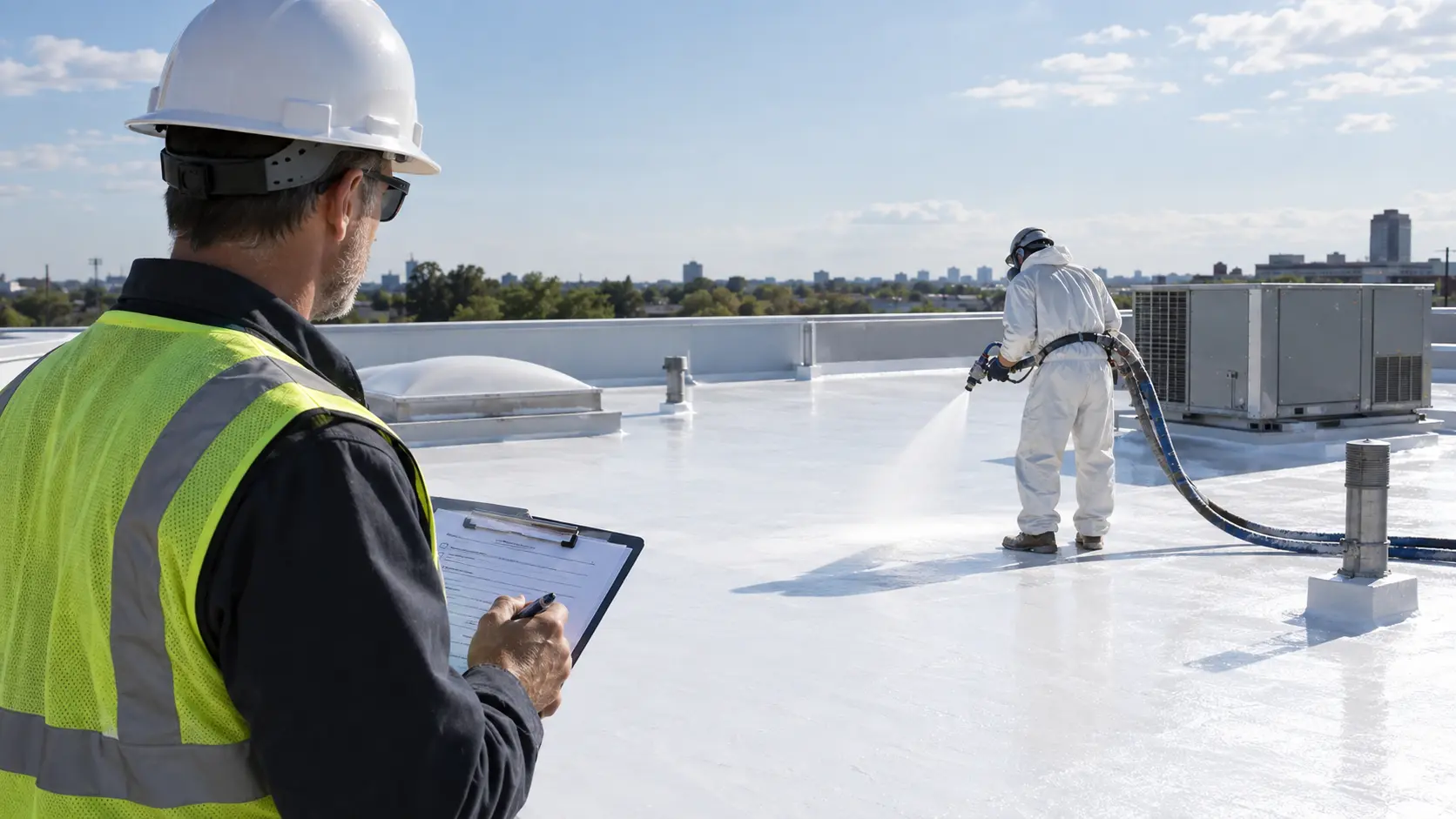
The white stuff is a polyurea coating. An inspector sees it on a roof and wants to know what product it is, who installed it, and whether it is holding. That question comes up on commercial buildings across Michigan and Florida, and a facilities manager who has watched a crew spray the roof still needs a straight answer about the chemistry.
What Polyurea Is
Polyurea is a two-component coating. Two liquid streams meet at the spray gun, react in seconds, and cure into a solid membrane. The reaction is fast enough that the coating sets without waiting on moisture in the air or a catalyst to kick it. The result is a seamless surface that goes down over an existing roof deck, not a sheeted product with laps and fasteners.
Why It Bonds to Old Metal and Concrete
A concrete deck is porous. The coating wets into that surface and grips it mechanically. A metal deck, particularly an older one, carries decades of oxidation, seams, and fastener heads. Polyurea handles those irregularities because it is sprayed as a liquid and cures in place, forming a continuous layer that covers the profile of the deck instead of sitting on top of it.
That bond is the reason the coating gets specified on roofs that already have a deck worth keeping. A flat roof coating candidate is usually a roof with sound substrate and failed surfacing, not one that has lost its structure. The same logic applies on industrial buildings. Industrial applications cover warehouses, plants, and food-grade facilities where a seamless, cleanable surface matters.
What the First Year Looks Like
Year one on a coated roof is the period when the membrane is doing its clearest work. The surface is uniform, the seams are gone, and water has nowhere to pool or travel underneath. On a metal roof, the rust that was creeping across panels and fastener heads stops advancing because the coating has sealed the surface. On concrete, the spalling and dusting that came from a failing top layer is capped.
Inspectors tend to look for adhesion, thickness, and the condition of terminations and penetrations. That is consistent with how roofing professionals evaluate assemblies. IIBEC publishes guidance on roof system assessments, and ASTM has standard test methods for coating properties. Both are worth knowing if a project file is going to be reviewed.
What Year Ten Looks Like
The ten-year mark is where a polyurea roof is judged on maintenance, not installation. A coated roof that has been kept clean and had penetrations re-sealed as needed holds its membrane. A coated roof that has been ignored shows the same stress points as any other roof: ponding at low spots, damaged flashing, and traffic wear around HVAC units.
The difference is that the fixes are local. A patch on a polyurea roof is a patch on a membrane, not a full replacement of a sheeted system. That is the practical argument for coating an existing deck rather than tearing it off. Restoration versus replacement is the decision most owners face when a roof is failing but the structure is not.
The coating performance also depends on climate. A Michigan roof sees freeze-thaw cycling and hail. A Florida roof sees UV and heat. Michigan commercial roof coating and Florida commercial roof coating are different conversations because the wear patterns are different.
What the Inspector Actually Wants
Most inspectors ask four things. What product was installed. Was it applied to the manufacturer's specification. Is the thickness what the spec calls for. And are the details at edges and penetrations sound. A coating file with product data, application records, and a warranty satisfies all four.
Code review happens at the local level, but model codes and product listings drive a lot of it. The International Code Council publishes the model codes many jurisdictions adopt. UL Solutions lists roof covering assemblies. FM Global approves roof systems for insurance purposes. If a polyurea assembly is part of a listed system, that listing is the document an inspector wants to see.
Cool roof requirements are another item that comes up. A white polyurea coating may qualify for a cool roof credit depending on its rated properties. The Cool Roof Rating Council maintains a directory of rated products. The EPA also publishes material on cool roofs and urban heat islands. Whether a given coating qualifies depends on its listing, not on its color.
What to Say If the Roof Was Coated Before You Got There
If a building changed hands or a prior manager left, the coating records may not exist. In that case the inspector is looking at the roof as-is. A roof assessment can identify the coating type, check adhesion, and document the condition. That documentation is what a maintenance plan gets built on.
For roof restoration and storm-related work, the same record-keeping applies. Storm damage roof restoration projects in particular need a paper trail because insurance may be involved. NOAA's billion-dollar disaster database tracks the scale of weather events that drive that work.
If the question is where to start, the answer is usually a roof assessment followed by a specification. The product data sheet and the application standard are the two documents that let an inspector sign off.
Where to Go Next
If you are a facilities manager or building owner in Michigan or Florida and an inspector has asked about the white coating on your roof, the next step is a roof assessment. AZ Coatings works on commercial and industrial roof restoration in both states. Contact the team to schedule an assessment, or read more on the polyurea roofing page and the blog for project-level detail.
Common questions
What is the white coating on a commercial roof?
It is usually a polyurea roof coating, a two-component spray-applied membrane that cures in place over an existing deck. It is seamless, so it covers metal seams and fasteners without laps.
How long does a polyurea roof coating last?
A coated roof's condition at year ten depends on maintenance. A roof that has been kept clean and had penetrations re-sealed holds its membrane; one that has been ignored shows wear at low spots and around HVAC units.
Does a polyurea roof coating qualify as a cool roof?
It can, depending on the product's rated properties. The Cool Roof Rating Council maintains a directory of rated products, and the EPA publishes material on cool roofs and heat islands.
What does a city inspector look for on a coated roof?
Product installed, application to the manufacturer's specification, thickness, and the condition of details at edges and penetrations. Model code, UL listings, and FM approvals often drive the review.