
The right roof coating for a warehouse depends on four things: what the roof is made of today, whether water sits on it after rain, how much foot traffic it takes, and what is stored underneath. On most warehouse flat roofs with ponding, rooftop units and inventory below, we use a polyurea system. Silicone can be a lower-cost choice on a roof that mostly faces sun and little else.
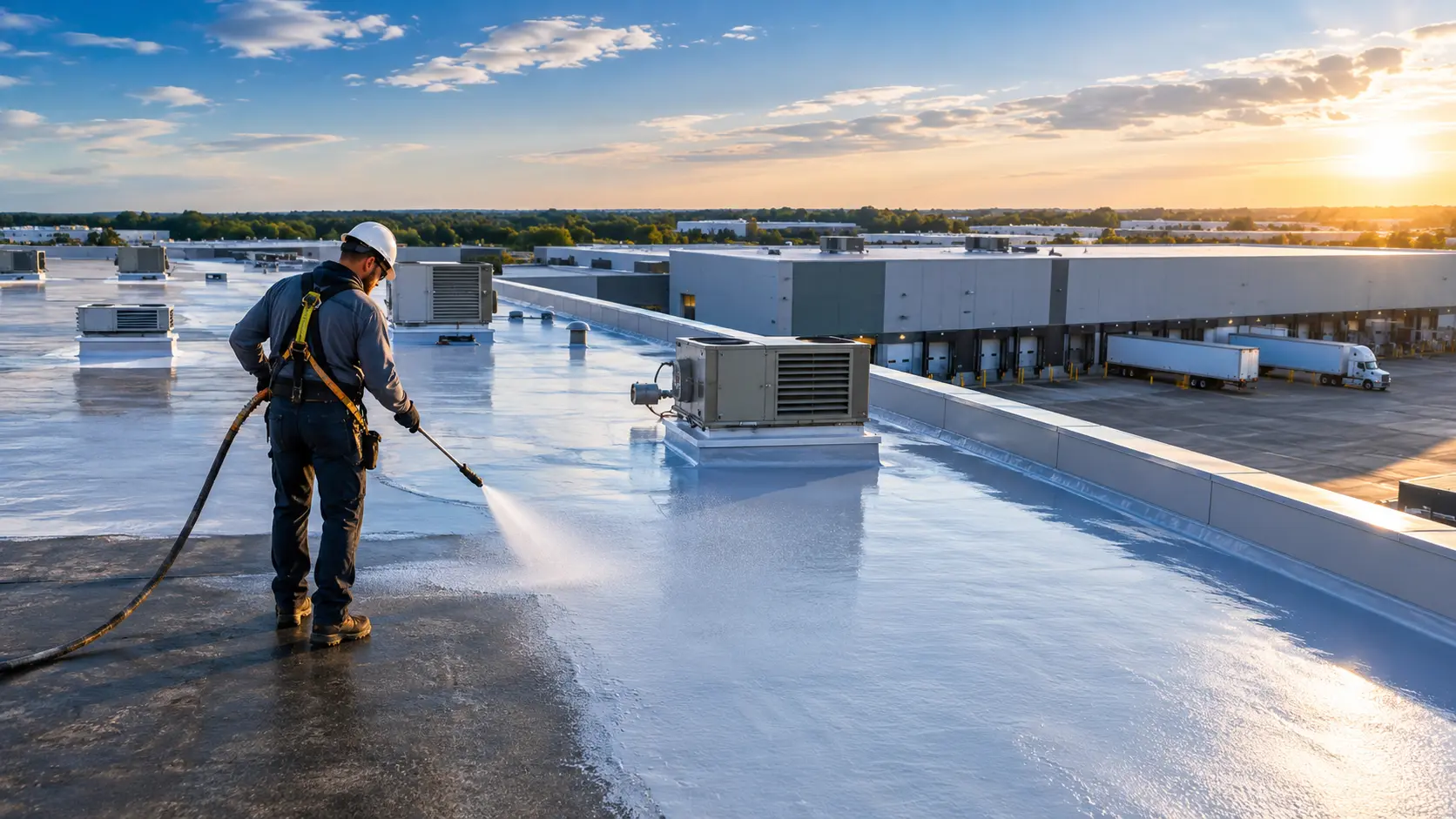
The rest of this page is how we tell the two situations apart.
Start with what is under the roof
A leak over an empty floor is an inconvenience. A leak over racked inventory, packaging lines or a server room is an insurance event. The more a warehouse loses when water gets in, the less a coating can be chosen on price per gallon.
Cold storage is its own case. Water on a cold storage ceiling is often condensation from the insulation and vapor retarder, not a roof leak, and a coating will not fix that. We cover the difference in when your warehouse ceiling sweats.
What is the roof made of now?
The existing surface decides more than any brochure. Here is how each common warehouse roof changes the choice.
- Modified bitumen or built-up roofing. Asphalt surfaces release oils. Without the correct bleed-block primer, those oils push a silicone coating off from below and the bond fails.
- Single-ply TPO or EPDM. Seams and the flashing around HVAC units are where these membranes fail first, so those areas get the most preparation.
- Spray foam or a sound waterproof membrane. Here silicone can work, because the layer underneath is already waterproof and the coating mainly protects it from UV.
- An existing silicone coating. This one limits the options. Very little bonds to cured silicone. Acrylic peels off it in sheets, and the realistic choices are more silicone after heavy preparation or removing it before any other system goes on.
Does water sit on it after rain?
Most warehouse roofs have low spots, and many hold water for a day or two after a storm. Water still on the roof 48 hours after rain counts as ponding, the definition the Asphalt Roofing Manufacturers Association uses in its ponding water guidance. Silicone is permeable, so water can work through it under sustained pressure. Polyurea cures into one continuous waterproof membrane with no seams, so standing water does not find a path into the roof. If the roof ponds, that alone usually settles the choice.
How much traffic does the roof take?
A warehouse roof is a work surface. HVAC technicians cross it every season, contractors drag equipment over it, and in Michigan it takes hail and heavy snow. A coating with low tear strength looks fine until someone drops a toolbox on it.
Polyurea is rated at 3,000 to 5,000 PSI of tensile strength, with 300 to 400 percent elongation, so it stretches with the roof and recovers. Silicone coatings sit far below that range, which is why we see them fail first around rooftop units and access paths.
How do the coatings compare in thickness?
Coating thickness is measured in mils, thousandths of an inch. Contractors often quote silicone in gallons per square because it sounds like more.
| System | Typical dry thickness |
|---|---|
| AZ Coatings polyurea system, base plus aliphatic topcoat | about 300 mils |
| Single-ply membrane, TPO, EPDM or PVC | 45 to 90 mils |
| Silicone coating at 2.5 gallons per square | 25 to 35 mils |
Elongation tells a similar story. Our polyurea stretches 300 to 400 percent before it tears, against roughly 150 to 200 percent for silicone, and that is the margin a warehouse roof uses every winter as it contracts and expands.
Thickness is most of what gives a coating its impact resistance. On a roof that takes hail or regular foot traffic, it is the number worth asking for in writing.
Can the warehouse stay open during the work?
In most cases, yes. A coating goes over the existing roof, so the deck is never opened to weather and work below continues. Polyurea also cures fast and can usually be walked on within minutes of application, which matters in Michigan, where spring and fall offer short dry windows that slower-curing silicone and acrylic coatings cannot always use.
When a coating is the wrong answer
A coating restores a roof that still has a sound structure under it. It is the wrong choice when the deck is soft underfoot, when a moisture survey shows the insulation is largely wet, or when leaks are spread across the whole field rather than concentrated at seams and penetrations. In those cases replacement is the honest recommendation. Our restoration or replacement guide walks through that decision, and is your flat roof a coating candidate covers the inspection itself.
What to ask before you sign
- What is the existing roof, and how will you prepare it?
- What dry thickness will the finished coating be, in mils?
- How will you handle the seams, fasteners and HVAC surrounds?
- Was a moisture survey done, and what did it show?
- What happens if the coating needs repair in ten years, and what bonds to it?
- Can the building operate normally during the work?
A contractor who answers each of these in writing has thought about your roof. One who answers in gallons per square is selling a product.
For a deeper look at the two most common choices, see our polyurea and silicone comparison. For warehouse and industrial roofs specifically, see industrial applications.
Common questions
What is the best roof coating for a warehouse?
It depends on the roof. For warehouse flat roofs with ponding water, rooftop equipment and inventory below, polyurea is the stronger choice because it forms a seamless waterproof membrane with high tensile strength. Silicone can be a lower-cost option on roofs that mainly face UV exposure without standing water or mechanical stress.
Can you coat a warehouse roof that already has silicone on it?
Options are limited. Very little bonds to cured silicone, and acrylic will peel off it. The realistic choices are recoating with silicone after heavy preparation, or removing the silicone before another system goes on.
Does the warehouse have to close while the roof is coated?
Usually not. The coating goes over the existing roof, so the deck stays sealed and operations below continue during the work.
Find out which situation your roof is in
We inspect warehouse roofs across Michigan and Southeast Florida and tell you what the roof needs before anyone quotes a product.
Request a warehouse roof inspection