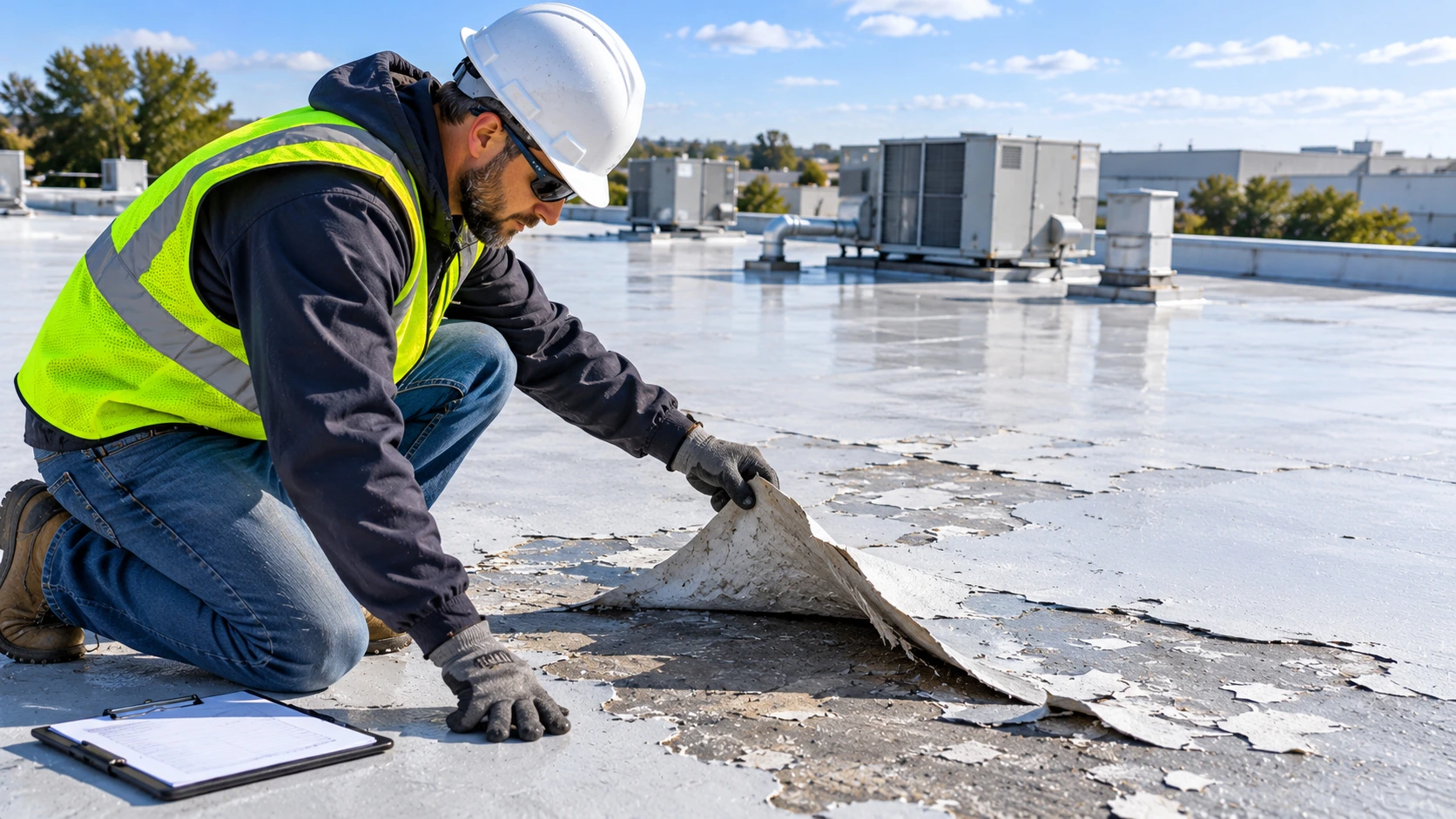
Peeling coating on a commercial roof is a symptom. It tells you the top layer let go of what was under it. That is not the same as telling you the roof is finished. The right next step depends on why it peeled, how much of the roof is affected and what is happening under the surface.
Read Where the Peel Is Happening
Where the coating lifts points to the cause. Coating peeling at seams and laps is often an adhesion problem, since seams move and collect dirt. Peeling across the whole field is a broader bond or moisture issue. Blisters that pop and leave bare membrane behind point to trapped moisture under the coating or in the assembly. Flaking with rust spots points to the metal underneath.
Look at the edges too. Curling at the perimeter, where the coating lifts in sheets, is a different failure than small chips around fasteners. Small, isolated spots on a metal roof can be prep-related. AZ Coatings deals with rusted or loose fasteners and corroded spots during prep on metal roofs, then sprays the membrane to seal fastener heads and laps as one surface, per its polyurea roofing page.
The age of the coating matters. A newer coat that peels in the first few seasons says something went wrong in prep or the substrate was not right. An older coat that is thinning and chalking is behaving like an aging surface, not a failed job.
Repair, Recoat or Tear-Off
A spot repair makes sense when the failure is isolated and the coating around it is still bonded. Cut out the loose material, fix what caused the peel, then re-coat that area with a compatible product. That only works if the substrate under the repair is sound and dry. If the coating is lifting across whole sections, spot repair just moves the problem around.
A full recoat makes sense when the coating above is failing but the roof assembly below is still solid. The existing membrane stays in place as the base, and the new coating is applied over it after cleaning, repair and priming. AZ Coatings describes that sequence on its polyurea roofing page: inspection and assessment, surface preparation (clean, repair, prime), application, quality inspection, then a final walkthrough with documentation.
A tear-off makes sense when the roof below the coating can't carry a new surface. Saturated insulation is the clearest case. AZ says isolated wet areas are cut out and replaced before coating, but if insulation is saturated across the whole roof, restoration is not the right fix, per its Flint polyurea roofing page. A deck that has lost structural integrity is another reason to tear off. So is a roof where the existing layers are incompatible with the coating being considered.
What the Inspection Checks
Three things usually decide the call:
- The deck. Is it sound, or is there give underfoot or visible deflection?
- The existing membrane. Is it still bonded, or is it loose in sections?
- Trapped moisture. Is water sitting under the surface, in the insulation or in the assembly?
AZ's free inspection covers those three areas, and the owner gets a quote before work starts. If the roof is not a good fit for restoration, the inspection says so, per the Almont page. That last point matters more than the quote: a contractor who tells you when restoration is the wrong answer is the one you can trust on the day it is the right one.
For roof assemblies where the design itself is in question, the National Roofing Contractors Association and IIBEC publish technical guidance on membrane and coating assemblies. The Spray Polyurethane Foam Alliance is the reference body for spray-applied systems and the Cool Roof Rating Council maintains a product directory for rated reflective coatings.
Questions to Ask Before You Sign
Ask what caused the peel. A crew that can name the cause can tell you whether the same failure will come back after a recoat. Ask whether moisture testing was done, and where the readings came from. Ask what the prep includes: cleaning, priming and repair should be spelled out before the application price is quoted.
Ask how the work will be phased. Restoration jobs can move across the roof in sections without opening the building, and the schedule can be planned around operating hours, per the Ann Arbor polyurea page. That matters for warehouses, manufacturing plants and shopping centers where the business has to keep running.
Ask about compatibility. The new coating has to bond to what is already on the roof, and the existing layers need to be identified before the product is picked. ASTM International publishes standards for coating and membrane test methods that a specifier can reference, at astm.org.
What a Sound Roof Is Worth
Restoring a sound roof typically costs 40 to 60 percent less than a full replacement, according to AZ Coatings' service overview. A properly specified and installed polyurea roof coating typically lasts 15 to 20+ years, depending on roof condition and maintenance, per the same source. Those two facts are why the diagnosis matters: restoration is worth the money when the roof underneath can carry it, and not when it can't.
AZ Coatings was founded in 2021 and rebranded from J&J Polyurea Roofing in 2026, with the same team, address and phone numbers. Warranties on work done as J&J carry over to AZ. Details are in whether a J&J Polyurea Roofing warranty still counts under AZ Coatings. The company works on warehouses, manufacturing facilities, shopping centers and large commercial buildings across its Michigan service area and Southeast Florida, and offers free commercial roof inspections and consultations through its about page.
Common questions
Can a peeling roof coating be recoated, or does it need a tear-off?
It depends on why it peeled and what is under it. Isolated wet areas can be cut out and replaced before coating, but if insulation is saturated across the whole roof, restoration is not the right fix. AZ Coatings checks the deck, the existing membrane and trapped moisture at inspection.
What does AZ Coatings check during a free commercial roof inspection?
The inspection checks the deck, the existing membrane and any trapped moisture. The owner gets a quote before work starts, and the inspection will say if the roof is not a good fit for restoration.
How long does a polyurea roof coating last?
A properly specified and installed polyurea roof coating typically lasts 15 to 20+ years, depending on roof condition and maintenance, according to AZ Coatings.
Where does AZ Coatings work?
AZ Coatings is headquartered in Almont, Michigan. Its primary Michigan service counties are Oakland, Macomb, Wayne, Lapeer, St. Clair and Genesee, with Washtenaw, Monroe and Livingston served on a project basis. In Florida it serves Miami-Dade, Broward and Palm Beach counties.