
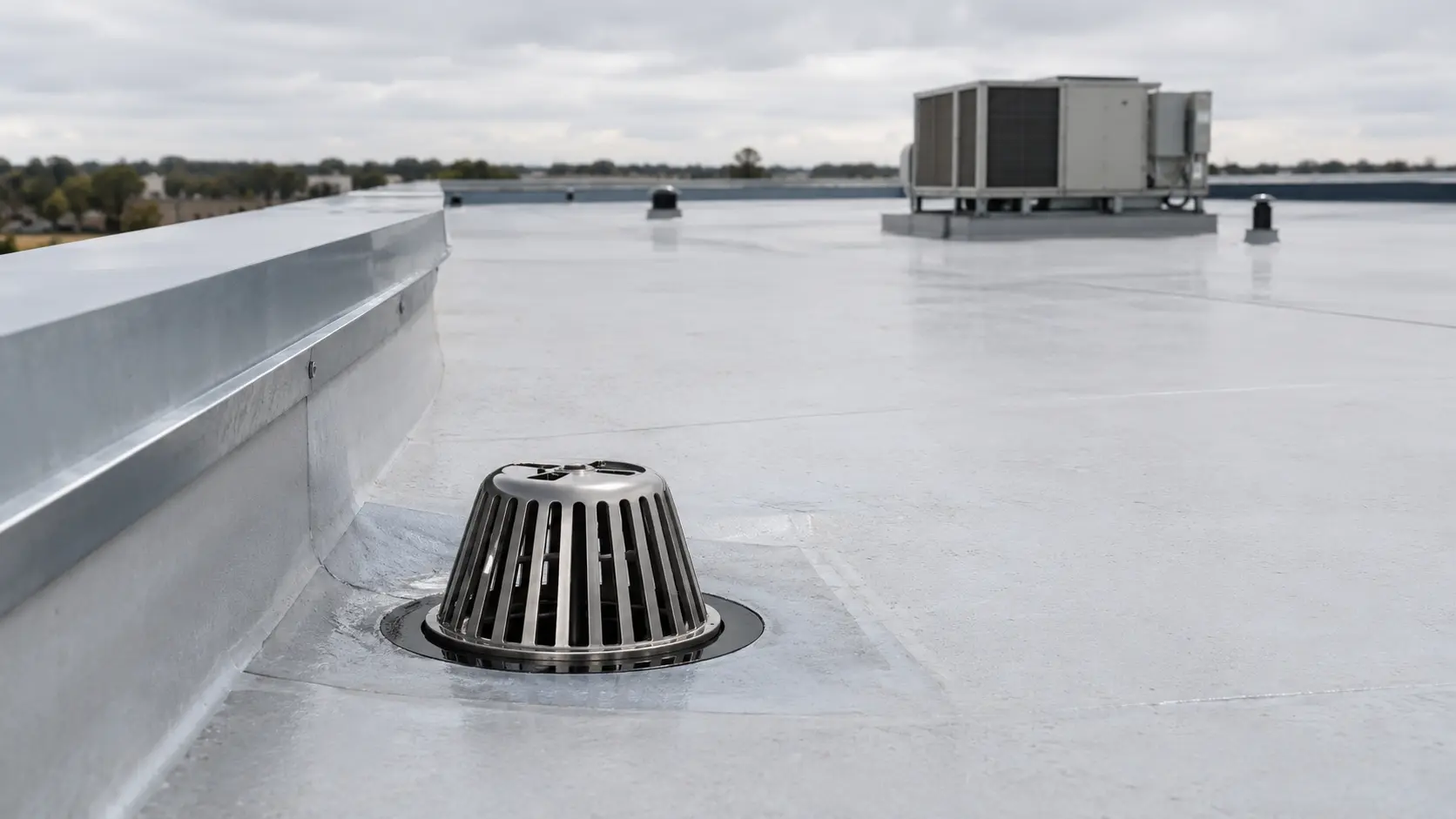
A commercial flat roof lasts longest when water leaves it quickly and has no way in. That means keeping drains, scuppers and gutters clear, keeping flashing and penetrations sealed, inspecting after storms and between seasons, and, on a coated roof, renewing the coating when inspection shows it wearing thin.
Flat roofs rarely wear out evenly. They fail where water sits and where something pierces the membrane. This routine is written for facility managers and building owners. It covers what to check and what each finding means, plus the one extra check a coated roof needs: how much coating is left, and whether it is still bonded.
Drainage First
A flat roof is built to move water off the building. When drainage slows, everything else on the roof spends more time wet: seams, flashing, the membrane surface and any coating on top of it. That is why drainage comes first in any maintenance routine.
Keep these clear:
- Roof drains and their strainers. A missing or broken strainer lets debris into the drain line, where you cannot see it.
- Scuppers at the roof edge, including any overflow scuppers.
- Gutters and downspouts that carry water from scuppers to the ground.
- The area around equipment curbs, where debris collects and holds water against the flashing.
Debris on a commercial roof includes leaves, windblown trash, sediment that settles out of standing water, and material left behind by trades servicing rooftop equipment, such as filters, screws and packaging.
After you clear a drain, watch it work in the next rain. Water should move toward it and leave. A drain that stays slow after clearing may be blocked further down the line, which is a job for a plumber or roofer rather than a broom.
Ponding Water as an Early Warning
Some water on a flat roof right after rain is expected. Ponding is water that is still there well after the rain has stopped and the roof has had time to drain. Ponding is a symptom of something else.
Ponding usually points to one of three causes:
- A drain, scupper or gutter that is partly blocked.
- A low spot in the roof surface or deck.
- A change below the surface, such as insulation that has taken on water and compressed. This one calls for a moisture check, and a cleanup will not fix it.
Standing water keeps the roof surface wet for longer, adds weight and collects dirt. Any small opening under a pond becomes a leak path. On coated roofs, ponding areas are also a common place for the coating to show wear first.
What to do when you find it
Photograph the pond and mark its outline so you can compare it at the next inspection. Clear the nearest drain. If the same area ponds again after the drain is clear, or the outline is growing, find the cause before it spreads.
Flashing, Penetrations and Seams
Flat roof leaks often start at transitions, where the roof meets something else, rather than in the open middle of the roof. These are the places to walk slowly:
- Wall and parapet flashing, including the metal that covers the top edge of the flashing.
- Roof edge metal and the corners where two edges meet.
- Curbs around HVAC units, hatches and skylights.
- Pipe and vent penetrations, including their boots and sealant.
- Equipment supports and anything fastened through the roof.
- Seams and laps in the membrane.
Look for sealant that has cracked, shrunk or pulled away. Look for flashing that is lifted, loose or split at the corners, and for laps that have opened. Around equipment, look for punctures, scuffs and dropped tools.
Rooftop equipment brings technicians onto the roof, and service work is a common source of new damage. Walk the area around any unit after it has been serviced, and ask the service company to report anything it disturbs.
Small openings at flashing and penetrations are usually quick to reseal or repair when they are caught early. Left open, they let water into the insulation, which turns a small repair into a larger one.
An Inspection Routine
The National Roofing Contractors Association puts a program of regular inspection and proper maintenance at the center of long-term roof performance. We break that program into three triggers:
- Between seasons, as part of a regular walk.
- After storms and heavy rain, while any damage is fresh.
- After any trade has worked on the roof.
| What to check | When | What to do |
|---|---|---|
| Drains, strainers, scuppers, gutters, downspouts | Between seasons; after storms | Remove debris. Replace missing strainers. Watch water drain in the next rain. |
| Standing water and low spots | After rain has had time to drain | Photograph and mark the outline. Compare it with the last inspection. Find the cause if it returns or grows. |
| Wall, parapet and edge flashing | Between seasons; after storms | Look for lifted, loose or split flashing and failed sealant. Reseal or repair. |
| Penetrations, curbs and equipment supports | Between seasons; after any trade work | Check boots, sealant and fasteners. Repair damage from service work. |
| Seams and membrane surface | Between seasons | Look for open laps, blisters, punctures and soft spots underfoot. |
| Coating surface (coated roofs only) | Between seasons | Look for chalking, thinning, cracking, peeling and bare spots. Record where and how much. |
| Ceilings and walls below the roof | After storms | Look for new stains or damp spots, and trace them back to the roof above. |
| Maintenance record | Every inspection | Log the date, photos, what you found and what was done. |
The record matters as much as the walk. A crack or a pond means more when you can see that it was not there last time.
Recoating as Maintenance on Coated Roofs
On a coated roof, the coating is the surface that takes the weather. Like any wearing surface, it wears. The maintenance routine for a coated roof therefore adds one question to every inspection: how much coating is left, and is it still bonded to the roof below?
Signs the coating is wearing
- Chalking: a powdery residue that rubs off on your hand.
- Thinning: the color or texture of the surface underneath starting to show through.
- Cracking: fine cracks across the surface, including areas away from seams.
- Peeling, blistering or lifting, most often at edges, seams and penetrations.
- Erosion where water ponds or where people walk to reach equipment.
- Dirt that stays after rain. All roof coatings and surfaces collect dirt over time.
The decision comes from the inspection
There is no fixed calendar for renewing a coating. The inspection sets the timing, and it answers two questions first: is the coating still bonded, and is the roof underneath dry? Bond comes first, because a renewal coat can only hold as well as the surface it goes on.
Wear is local, coating bonded, roof dry
Repair the worn area. There is no need to recoat the whole roof for a worn walkway or one ponding spot.
Wear is widespread, coating bonded, roof dry
This is where a recoat fits. The surface is cleaned and prepared, and a new coat goes over the existing system. It renews the wearing surface without removing what is underneath, including on polyurea roofing systems.
Coating loose, or the roof below is wet
A recoat will not fix this. Coating over a loose layer or wet insulation hides the problem instead of solving it. The roof needs a proper assessment first.
If the coating was chosen partly for how much sunlight it reflects, keep in mind that the Cool Roof Rating Council rates roof products both when new and after outdoor weathering, as its testing FAQs explain. When you compare coatings, ask for the aged rating as well as the initial one.
When Maintenance Is No Longer Enough
Maintenance keeps a sound roof sound. It cannot bring back a roof that is failing underneath. These signs mean the question has changed from "what do we fix?" to "restore or replace?":
- Leaks keep returning, and in new places.
- Ponding areas keep growing after drains are clear.
- Soft or spongy spots underfoot, which usually mean wet insulation or deck damage.
- The membrane is separating or missing in sections.
- The coating is failing across large areas rather than in patches.
At that point, a walk is not enough. You need to know what is wet under the surface. Our guide on how we decide between restoring and replacing a commercial roof explains how that call gets made. For an older roof, read what restoration can and cannot do for a roof near the end of its life. If restoration is on the table, the step-by-step process for restoring a commercial flat roof shows what the work involves.
Where to Go Next
If your roof has not been walked since the last storm season, start with the drains and the flashing. If you would like a second set of eyes on a roof you manage in Michigan or Florida, contact the AZ Coatings team to schedule a roof assessment, or read more on the blog for project-level detail.
Common questions
How often should a commercial flat roof be inspected?
Inspect it between seasons, after storms or heavy rain, and after any contractor has worked on rooftop equipment. Keep a dated record with photos each time, so changes show up between visits.
Is it normal for water to sit on a flat roof after it rains?
Water that clears as the roof drains is expected. Water that is still there well after the rain has stopped is ponding. It has a cause, usually a blocked drain or a low spot, and it is worth finding.
Can our building staff clear the roof drains?
Staff with safe roof access can often lift loose debris off strainers and out of scuppers. A drain that stays slow after clearing, or any damaged flashing around it, is work for a roofer.
What is different about maintaining a coated roof?
The routine is the same, with one addition: at each inspection, check the coating surface for chalking, thinning, cracking and peeling, and note where the wear shows. That record tells you when renewal is due.
How do I know whether my roof needs a recoat or a restoration?
A recoat fits when the coating is worn across the surface but still bonded, and the roof underneath is dry. If the coating is loose or the roof below is wet, the roof needs an assessment before any new coating goes on.
Why keep maintenance records at all?
Records turn separate inspections into a trend. They show whether a pond is growing, whether a repair held, and whether wear is speeding up.